Hello, from Zippy! = )

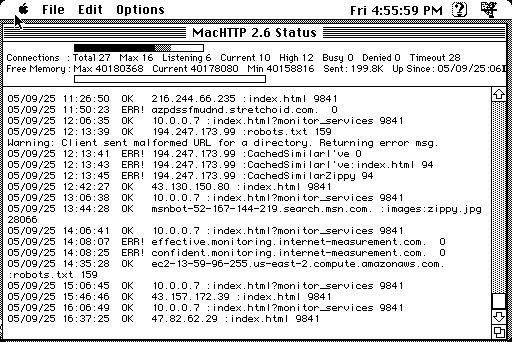
The image above is a live snapshot of Zippy’s screen, showing the MacHTTP web-server log. Each time someone visits this page, the log records the request. If JavaScript is enabled, the image refreshes periodically so you can watch the server activity.
About Zippy
Zippy is a Macintosh SE/30 from 1989—an impressive piece of vintage technology that still serves this web page -n- after its introduction!
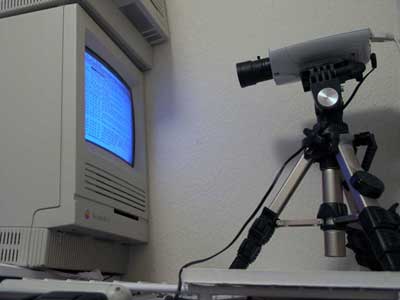
When the physical computer is running, a network camera takes periodic snapshots of its screen. Zippy is currently taking a break (either I'm working on the hardware, or he's taking a well-earned rest in a cozy box). In the meantime, its operating system and web server are running in Basilisk II, a 68k Macintosh emulator hosted on an old Intel Mac mini.
Zippy's Configuration
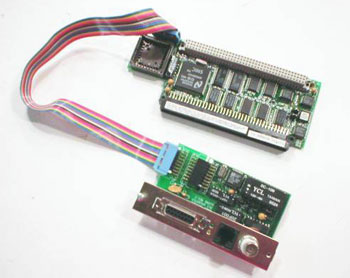
Zippy has 80 MB of RAM and runs Mac OS 7.5.5. An Asante MacCon 10BASE-T Ethernet card in the SE/30 PDS expansion slot connects Zippy to the network. And MacHTTP 2.6 serves this page to you. Before I replaced the spinning rust drive with a BlueSCSI, I used a utility called Sleeper to put the hard drive to sleep on idle. And I use Shareway IP Personal to access Zippy's files over the network.
About the Macintosh SE/30
Introduced in 1989, the Macintosh SE/30 (EveryMac specifications) is widely recognized as one of the most popular and capable compact Macs from Apple's early days. Its CPU, CRT display, hard drive, and floppy drive fit inside a small, beige case modeled on the original Macintosh design.
The SE/30 launched at $6,500 and was discontinued in 1990. It was the first compact Macintosh to include Apple's FDHD 1.4 MB "SuperDrive" as standard, allowing it to read and write DOS format diskettes. It was also the first compact Macintosh that supported more than 4 MB of RAM.
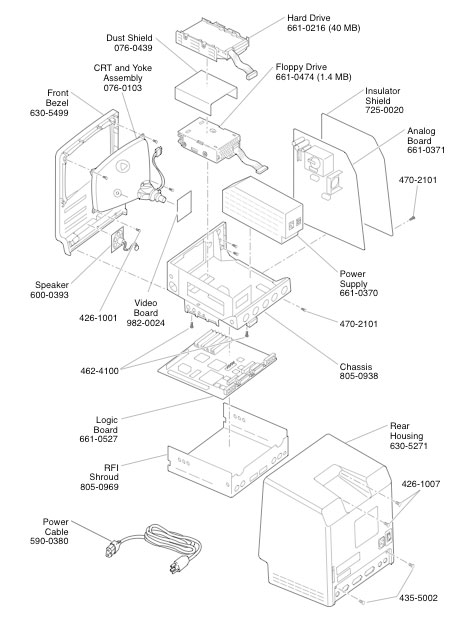
Exploded view of the Macintosh SE/30 showing internal components
Key specifications:
- a 9-inch monochrome CRT display at 512 × 342-pixel resolution
- a 16 MHz 32-bit Motorola 68030 microprocessor
- Apple's partially-32-bit (also called "32-bit dirty") 256 kilobyte Old World Mac ROM chip
- eight 30-pin SIMM RAM slots (expandable to 128 MB)
- a 120-pin, EuroDIN PDS expansion slot
- a 40 or 80 MB SCSI drive, and or:
- a 1.4 MB "SuperDrive" FDHD floppy drive
- two ADB ports
- two 8-pin DIN 45326 serial ports
- an external DB-25 SCSI port
Apple introduced this SE/30 the same year that Tim Berners-Lee published his proposal for a global information-management system—the foundation of the World Wide Web! Berners-Lee later developed the first web browser and web server on a NeXT computer, whose operating system ultimately became part of the technology behind macOS.
Also in 1989, Apple’s Macintosh developer group introduced Clarus the dogcow, one of the most memorable Macintosh mascots in Macintosh history. Read a reproduction of the original Apple technote, download Technical Note 1031 as a PDF, or visit the Moof Museum for more information.
References
For more details about this model Macintosh, see:
- Apple's Macintosh SE/30 Technical Specifications
- LowEndMac.com's Macintosh SE/30 Page
- EveryMac.com's Macintosh SE/30 Page
- Wikipedia's Macintosh SE/30 Page
Vintage Macintosh Web Servers
This web site is dedicated to my father, who introduced me to computing and programming at a young age.